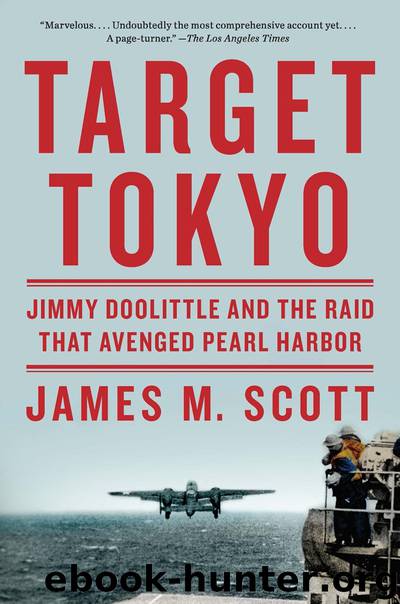
Target Tokyo: Jimmy Doolittle and the Raid That Avenged Pearl Harbor by James M. Scott
Author:James M. Scott [Scott, James M.]
Language: eng
Format: azw3
Tags: World War II, Aviation, 20th Century, Asia, Americas, United States, Military, Japan, Pulitzer Prize Finalist 2016 HISTORY, History
ISBN: 9780393246766
Publisher: W. W. Norton & Company
Published: 2015-04-13T05:00:00+00:00
CHAPTER 20
I was beaten, kicked and pummeled pretty regularly by the Japanese and systematically starved every day.
—GEORGE BARR, MAY 12, 1946
THE CREWMEN OF THE Green Hornet were not so lucky. The plane carrying Chase Nielsen, Dean Hallmark, and Bob Meder touched down in Tokyo at 7 p.m. on April 25. Guards ushered the men into cars, and after an hourlong ride the fliers arrived at the headquarters of the gendarmerie, whose brutal reputation was best described in a 1942 intelligence report. “The gendarmerie is the worst element in the Japanese Armed Forces,” the report stated. “They have no respect for man, woman or child. Gambling, narcotics, kidnappings, deliberate murder, prostitution, graft of all kinds and terrible torture are all in the day’s work. They will even deliberately kill their own nationals to create an incident if this is the only excuse they can find to obtain the end they desire.”
Once inside, guards removed Nielsen’s blindfold, exposing to him a bare room that contained only a table and three chairs. He was joined by an unarmed Japanese civilian. Nielsen was still handcuffed, but a guard stood by the doors. The civilian told him his name was Ohara and that he was a graduate of Columbia University.
“But Ohara is an Irish name,” Nielsen said.
“I realize that,” he answered. “But it is still my name.”
Nielsen guessed the short-statured Ohara was in his late twenties and appeared confident to the point of cockiness. He started to rattle on about baseball, talking about how much the Japanese worshipped Babe Ruth. The interrogator then changed topics. “I suppose you know Tokyo was bombed last week?”
“It was?” Nielsen replied, feigning surprise. “Who did it?”
Ohara chatted again about sports, but this time Nielsen interrupted him. “What do you think about President Roosevelt?”
“I’d like to hit him in the face with a rotten tomato,” Ohara barked.
“You can say that now that you’re back in Tokyo,” Nielsen said with a smile.
Ohara assured Nielsen he would not be mistreated. “You can play baseball and golf and enjoy the hot baths of Japan.”
Nielsen would soon learn how far from the truth that assurance was.
The door opened, and a Japanese officer with short hair entered. Ohara left, replaced by a short baldheaded interpreter who Nielsen estimated was in his midsixties. He told Nielsen and the other airmen he had graduated from Stanford University and spent thirty-five years in Sacramento, working as a lawyer for Japanese farmers along the West Coast. Nielsen would spend a lot of time with the interpreter, who began every sentence with a stock answer. “Well, well,” he would always say, “we’ll have to see about that.” Nielsen and the others soon nicknamed him Well-Well.
“I made a fortune,” Well-Well said, “and came back to Japan to retire, but they cleaned me out and here I am.”
The questioning began again. Where did Nielsen come from? Had he bombed Tokyo? Was he stationed in China or the Philippines?
The interrogation by three guards, two reporters, and the interpreter dragged on until about 4 a.
Download
This site does not store any files on its server. We only index and link to content provided by other sites. Please contact the content providers to delete copyright contents if any and email us, we'll remove relevant links or contents immediately.
| Africa | Americas |
| Arctic & Antarctica | Asia |
| Australia & Oceania | Europe |
| Middle East | Russia |
| United States | World |
| Ancient Civilizations | Military |
| Historical Study & Educational Resources |
The Sympathizer by Viet Thanh Nguyen(4440)
The Rape of Nanking by Iris Chang(4255)
World without end by Ken Follett(3510)
Ants Among Elephants by Sujatha Gidla(3494)
Blood and Sand by Alex Von Tunzelmann(3238)
Japanese Design by Patricia J. Graham(3213)
The Queen of Nothing by Holly Black(2656)
City of Djinns: a year in Delhi by William Dalrymple(2580)
India's Ancient Past by R.S. Sharma(2492)
Foreign Devils on the Silk Road: The Search for the Lost Treasures of Central Asia by Peter Hopkirk(2482)
Inglorious Empire by Shashi Tharoor(2462)
Tokyo by Rob Goss(2461)
In Order to Live: A North Korean Girl's Journey to Freedom by Yeonmi Park(2408)
Tokyo Geek's Guide: Manga, Anime, Gaming, Cosplay, Toys, Idols & More - The Ultimate Guide to Japan's Otaku Culture by Simone Gianni(2400)
India's biggest cover-up by Dhar Anuj(2381)
The Great Game: On Secret Service in High Asia by Peter Hopkirk(2371)
Goodbye Madame Butterfly(2275)
Batik by Rudolf Smend(2210)
Living Silence in Burma by Christina Fink(2093)
